Glossary
B
- batch data pipeline
-
A data pipeline that operates on batches of data. A batch is a set of data elements that are processed at the same time.
See also: data pipeline Used in: Batch Data Pipeline Infrastructure
C
- convolutional neural network (CNN, conv. net)
-
A neural network that has the convolution operation among its linear operations.
An early example is LeNet[1]:
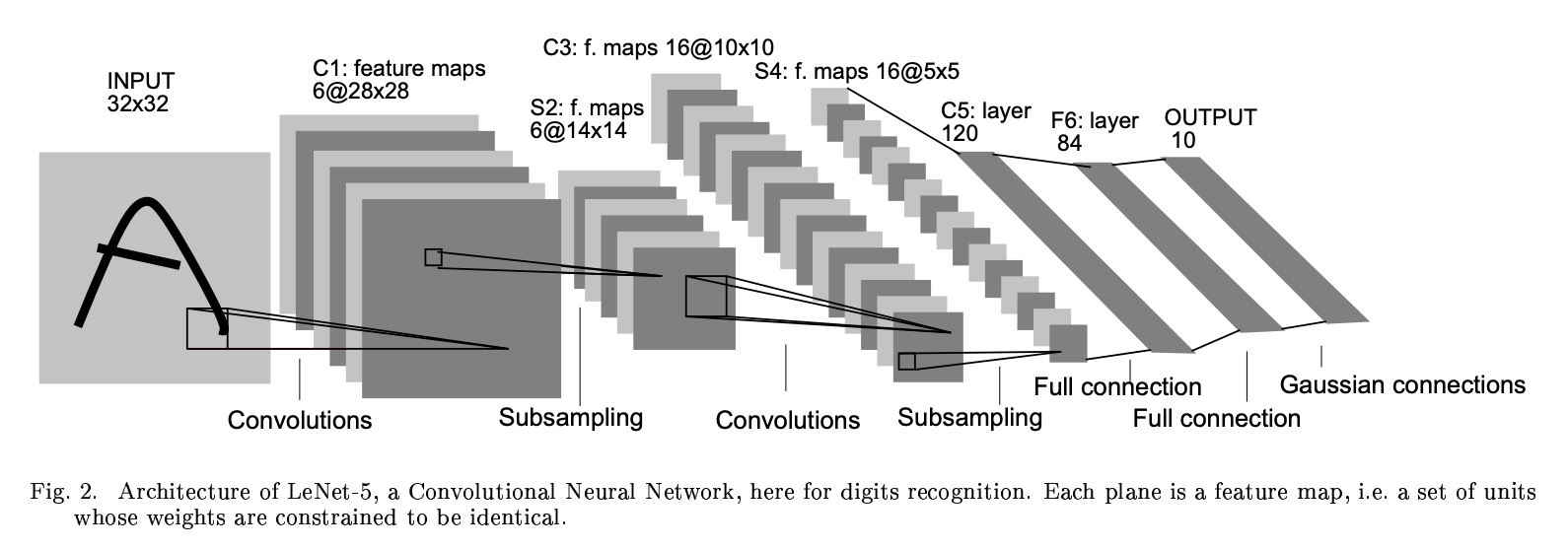
The LeNet architecture. CNNs are based on discoveries about how brains work[2]:
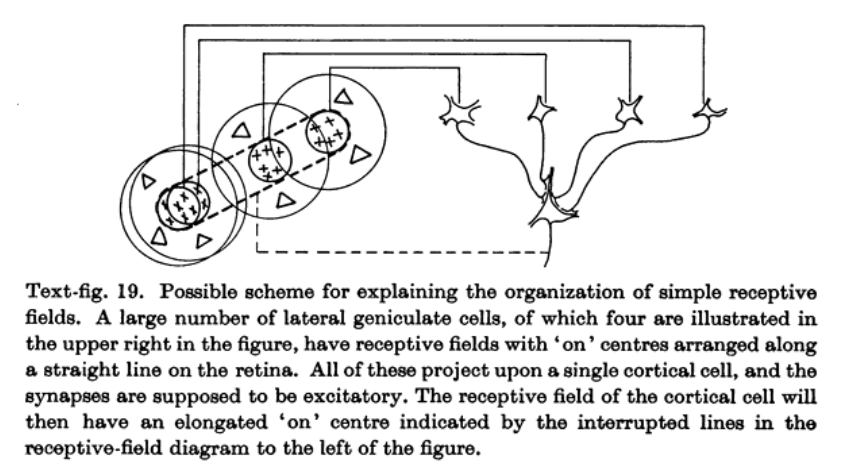
Illustration of "simple cells" by Hubel & Wiesel. Visual neuron type A related PyTorch module Function "Simple cell" nn.Conv2d Detects patterns "Complex cell" nn.MaxPool2d Aggregates detections See also: neural network Used in: The Alchemy of Semi-Supervision, Making Neural Networks Run Fast
D
- data pipeline
-
A computational graph that's run in stages. Usually has a high degree of parallelism.
E
- executor (data pipelines)
-
Logic that runs parallel operations across machines.
See also: orchestrator (data pipelines), task scheduler Used in: Batch Data Pipeline Infrastructure
H
- hard disk drive (HDD)
-
Used in: Making Neural Networks Run Fast
M
- machine learning (ML)
-
Using data to create logic.
Both statistics & machine learning study the use of observations to make inferences.
In my view, the key differences are:
- The ML community leans more into procedural, algorithmic methods.
- The ML community can place less necessity on theoretical understanding of methods, and more value on emperical validation.
Used in: The Alchemy of Semi-Supervision, Making Neural Networks Run Fast, Batch Data Pipeline Infrastructure
N
- neural network
-
A statistical model that relates input random variables to output random variables via a sequence of linear & non-linear operations.
See also: convolutional neural network Used in: Making Neural Networks Run Fast
O
- orchestrator (data pipelines)
-
Logic that resolves dependencies between stages and decides what runs when.
See also: executor (data pipelines), task scheduler Used in: Batch Data Pipeline Infrastructure
S
- semantic segmentation
-
The computer vision task concerned with estimating , where is a natural image and is a per-pixel classification image.
Also known as image segmentation.
I think it's the most simply posed task in computer vision.
- One might say: "isn't whole-image classification simpler?"
- Consider: you could have many classes in an image, but with per-pixel classification, it's more feasible to have one unambiguous class per pixel.
Used in: The Alchemy of Semi-Supervision
- One might say: "isn't whole-image classification simpler?"
- solid state drive (SSD)
-
Used in: Making Neural Networks Run Fast
- state of the art (SOTA)
-
The best known result for a task.
Used in: The Alchemy of Semi-Supervision
- stream data pipeline
-
A data pipeline that operates on streams of data. A stream is a sequence of data elements that are not processed at the same time.
See also: data pipeline
T
- task scheduler
-
Logic that assigns jobs to machines.
See also: orchestrator (data pipelines), executor (data pipelines) Used in: Batch Data Pipeline Infrastructure
U
- U-Net
-
An image-to-image model architecture introduced in a 2015 paper[1].
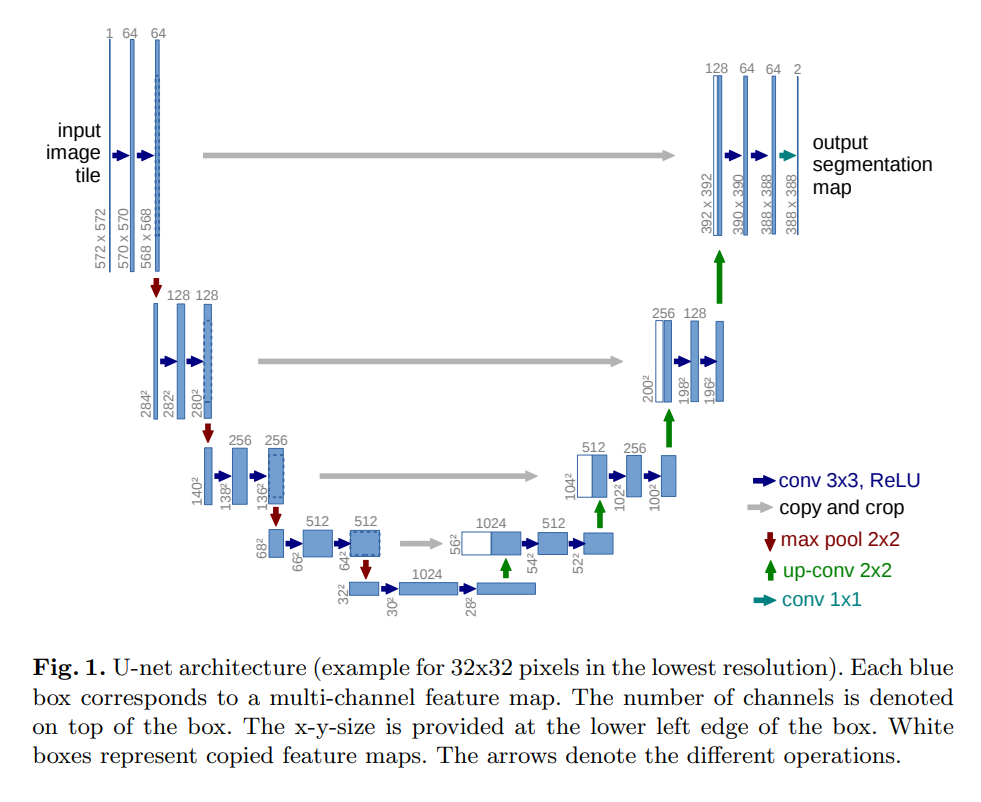
U-Net diagram from original paper. I think U-Net can be "derived" in a sequence of simple steps.
Step 1. Premise
Say we want to create an image-to-image model using convolutions:

"F" - feature maps, "C" - convolution operations. Step 2. Backbone
To learn useful representations, we might want to have a VGGNet-style backbone, that applies filters & downsamples repeatedly.
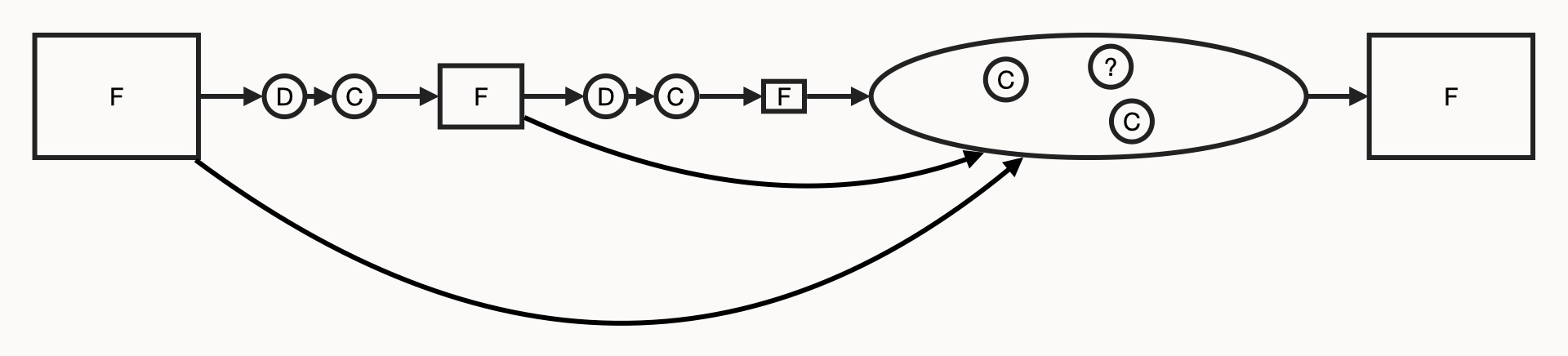
"F" - feature maps, "C" - convolution operations,
"D" - downsampling operations.Step 3. Skip-connections
We ultimately want to produce an image output.
And residual connections are useful in neural networks (it's been shown empirically, and I think it makes sense theoretically, because they introduce redundancy).
We upsample with a reverse backbone, and wire it up with the existing backbone:
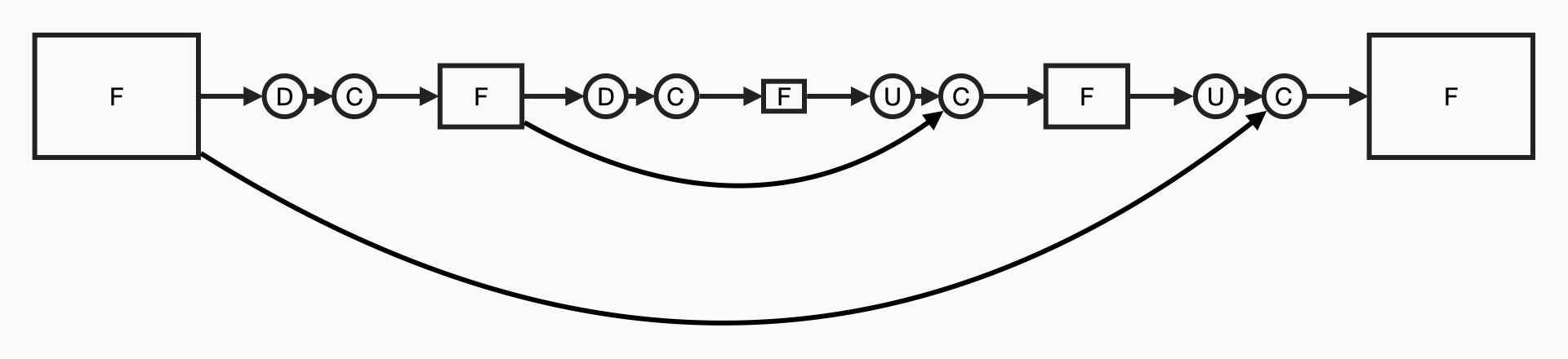
"F" - feature maps, "C" - convolution operations,
"D" - downsampling operations, "U" - upsampling operations.And now this is the essential form of U-Net:
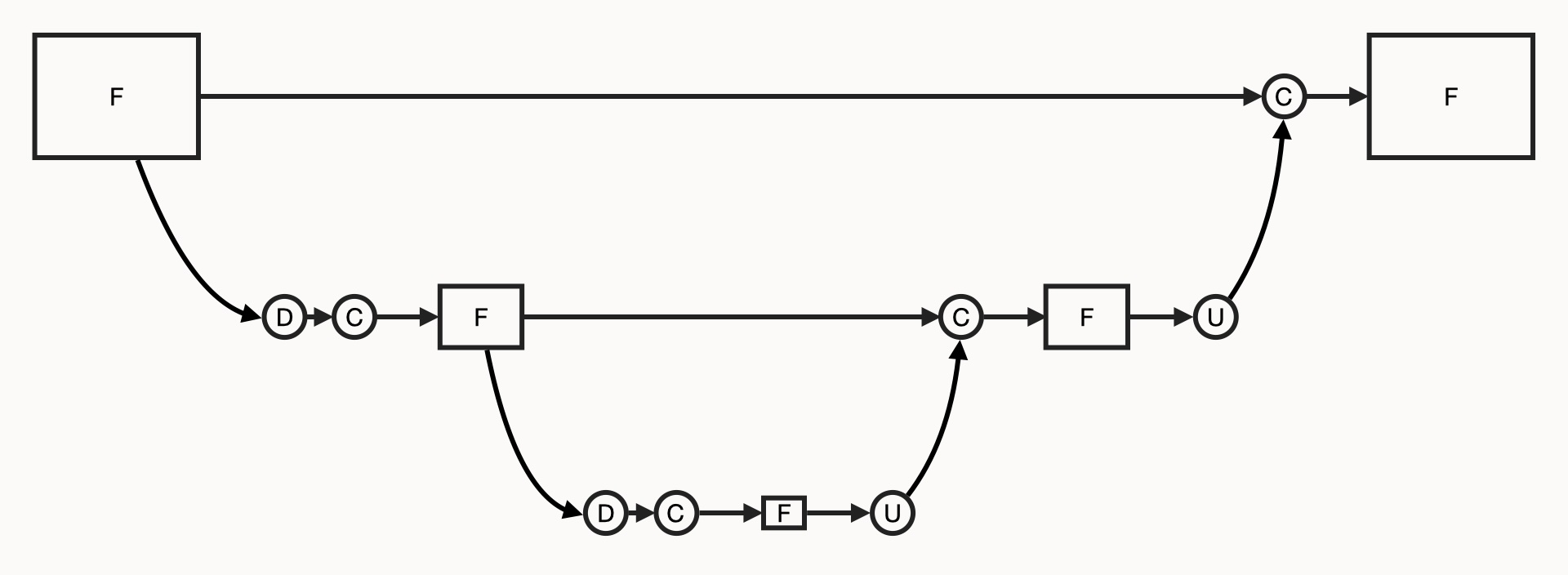
"F" - feature maps, "C" - convolution operations,
"D" - downsampling operations, "U" - upsampling operations.U-Net: Convolutional Networks for Biomedical Image Segmentation by Ronneberger, Fischer, and Brox ↩︎
See also: convolutional neural network Used in: The Alchemy of Semi-Supervision, Making Neural Networks Run Fast